Embracing the Post-Industrial Landscape
Art for the Environment
I am working on a series of coastal seascapes that use the visual vocabulary of Tonalism to re-imagine our relationship with the post-industrial landscape.
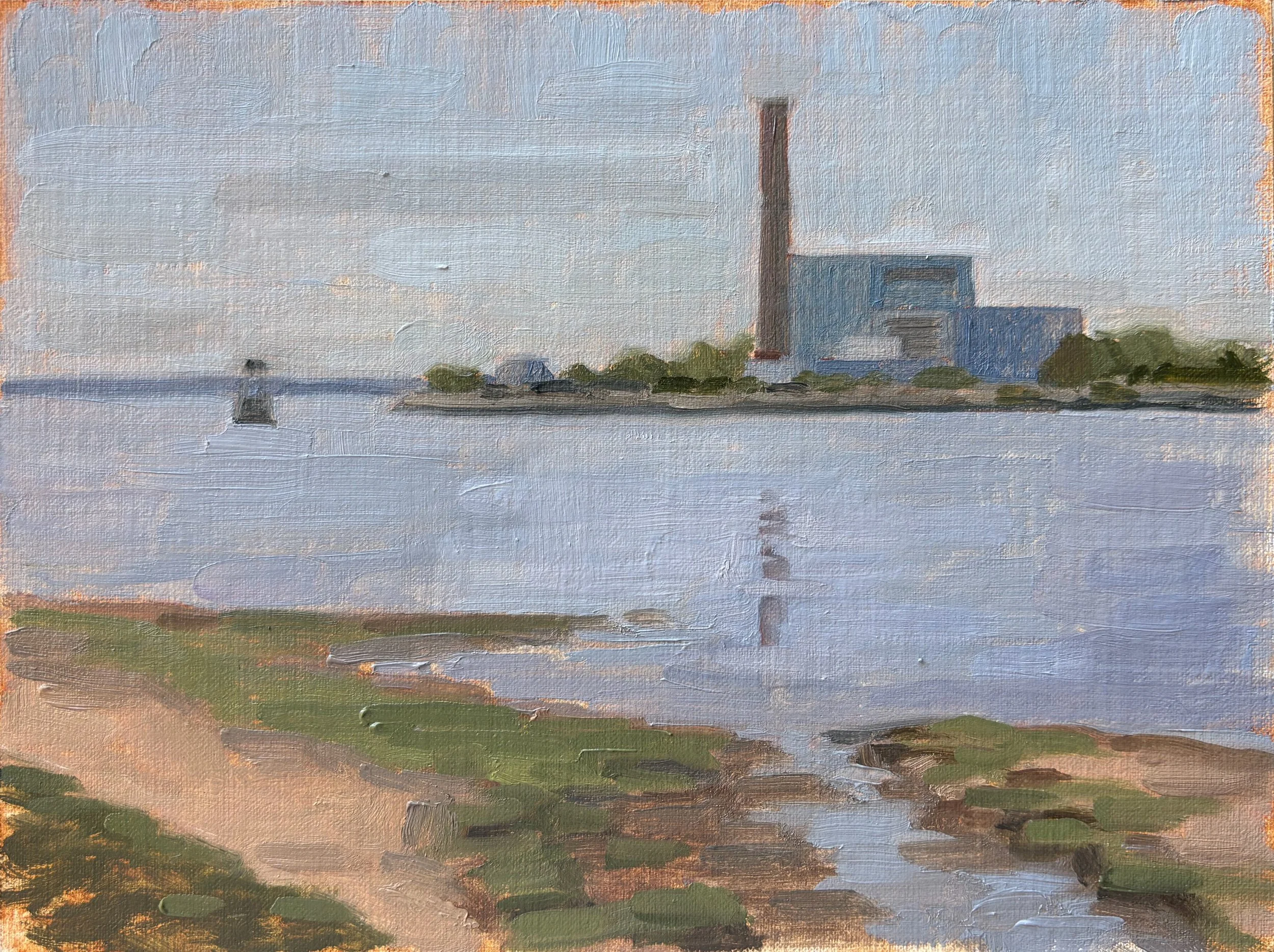
Study of Calf Pasture Beach, 2026. Oil on panel, 6×9 inches.
Why Now?
As the Long Island Watershed region looks back on its transformation from an industrial to an information-based economy, our coastal community confronts the task of integrating legacy physical structures and environmental impacts into the landscape.
An upcoming museum exhibit of paintings and prints in Fall 2027 will use the visual language of Tonalism to re-assesses our relationship with the post-industrial landscape, moving beyond periods of neglect, protest, and denial to embrace the complexities of re-integration.
Our Post-Industrial Coastline
Historically, landscape painting has provided an escapist refuge and a spiritual antidote to industrialization. 19th Century Naturalists such as James Audubon have utilized traditional illustration techniques to document and preserve knowledge of threatened species. Other artistic movements such as Transcendentalism, The Hudson River School, and Impressionism have explored humanity’s relationship with nature through mythologizing, sentimentality, and transformation.
As the coastal Connecticut region has transitioned from the industrial era to an information economy based on financial services and healthcare, these historical approaches are ripe for re-assessment. In this era of late-stage capitalism, artists have an opportunity to establish a new visual vocabulary to re-imagine our current relationship with nature. Our post-industrial ecosystem requires toxic cleanup and the re-integration of physical structures that carry problematic architectural legacies.
The benefits of hindsight, technological advances in environmental science, public awareness, and privileged financial resources present an opportunity. The Long Island Watershed community can engage artists to collectively re-imagine our connection with the coastal environment.
A vision of re-integration may allow us to transcend the cycles of neglect, protest, and denial that have defined previous decades. Recent initiatives such as the dramatic healing of hypoxia zones in Long Island Sound and the Manresa project in Norwalk illustrate emerging holistic approaches to environmental restoration and re-integration.
The Vision
The late 19th-century development of Tonalism in New England provides an aesthetic vocabulary of introspective, quiet poetry, restraint, reverence for nature, and embrace of ambiguity that is well-suited for addressing contemporary themes, including:
The complexities of cleanup and development trade-offs.
The legacy of environmental damage, counterbalanced by an emotionally hopeful outlook informed by new technologies, AI-powered environmental science, and mature conservation efforts.
A cultural shift from neglect and despair toward a holistic vision of unsentimental re-integration.
As noted by art historian David Cleveland in A History of American Tonalism 1880-1920:
“Tonalism invoked the silence, solitude, and secret yearnings of the private imagination, touching on man’s sometimes perplexing relationships with both nature and society…It was an art for uncertain times.”
The exhibition will strive for a paradoxical balance: expressive of deep sentiment yet devoid of sentimentality, representational yet fundamentally abstract, both real and poetically ethereal.
Building on the heritage of New England Tonalism, this exhibition seeks to establish a visual vocabulary for reimagining our relationship with the post-industrial landscape. Employing modern American Tonalism as an art for uncertain times, the works presented will embody an aesthetic that is introspective and rich in moody light effects, characterized by ambiguity and resistance to oversimplification.
References
What Is Tonalism? (12 Essential Characteristics) by David Adams Cleveland (Artnet)